This post contains affiliate links. If you purchase through these links, we may earn a commission at no additional cost to you.
For disclosure rules and endorsement guidance, see the FTC Endorsement Guides and Disclosures 101 for Social Media Influencers.
TL;DR
Affiliate marketing for beginners is easiest to understand as a tracked referral model: an affiliate recommends a product, uses a tracked link, and may earn a commission if someone buys through that link. The hard part is earning trust, choosing offers carefully, setting honest expectations, and building a system that does not depend on hype.
- Affiliate marketing is a referral model, not guaranteed income.
- A tracked affiliate link connects a visitor, an affiliate, an offer, and a commission event.
- Good affiliates help buyers make better decisions before they spend money.
- Disclosure matters because readers should know when a recommendation can earn a commission.
- The best long-term approach is to review fewer offers, explain tradeoffs clearly, and send people only to products that fit a real need.
Affiliate marketing gets described in two very different ways. Sales pages often make it sound like a shortcut. Skeptics often make it sound like every affiliate promotion is dishonest. Both views miss the practical middle.
At its best, affiliate marketing is a way for publishers, reviewers, creators, and educators to get paid for helping people choose useful products. At its worst, it becomes a commission-first habit where the affiliate promotes whatever pays the most. Marketing Review Lab is built around the first model.
This guide explains the mechanics, the risks, and the realistic work behind affiliate marketing. It also shows how the Marketing Review Lab review process fits into that model.
Table of Contents
What is affiliate marketing?
Affiliate marketing is a performance-based referral arrangement. A company or vendor pays an affiliate when the affiliate helps generate a tracked action, usually a sale.
The affiliate does not usually own the product, process the payment, or deliver customer support. The affiliate's job is to introduce, explain, compare, review, demonstrate, or recommend the offer. The vendor's job is to sell and support the product.
In a basic affiliate relationship, four parts matter:
- The vendor or merchant that sells the product.
- The affiliate who recommends or explains the product.
- The buyer who clicks, evaluates, and decides.
- The tracking system that connects the referral to the affiliate.
Affiliate marketing can happen through blogs, YouTube videos, email lists, paid ads, social posts, comparison pages, bonus pages, webinars, or private communities. The channel changes, but the core model stays the same.
How does affiliate marketing work step by step?
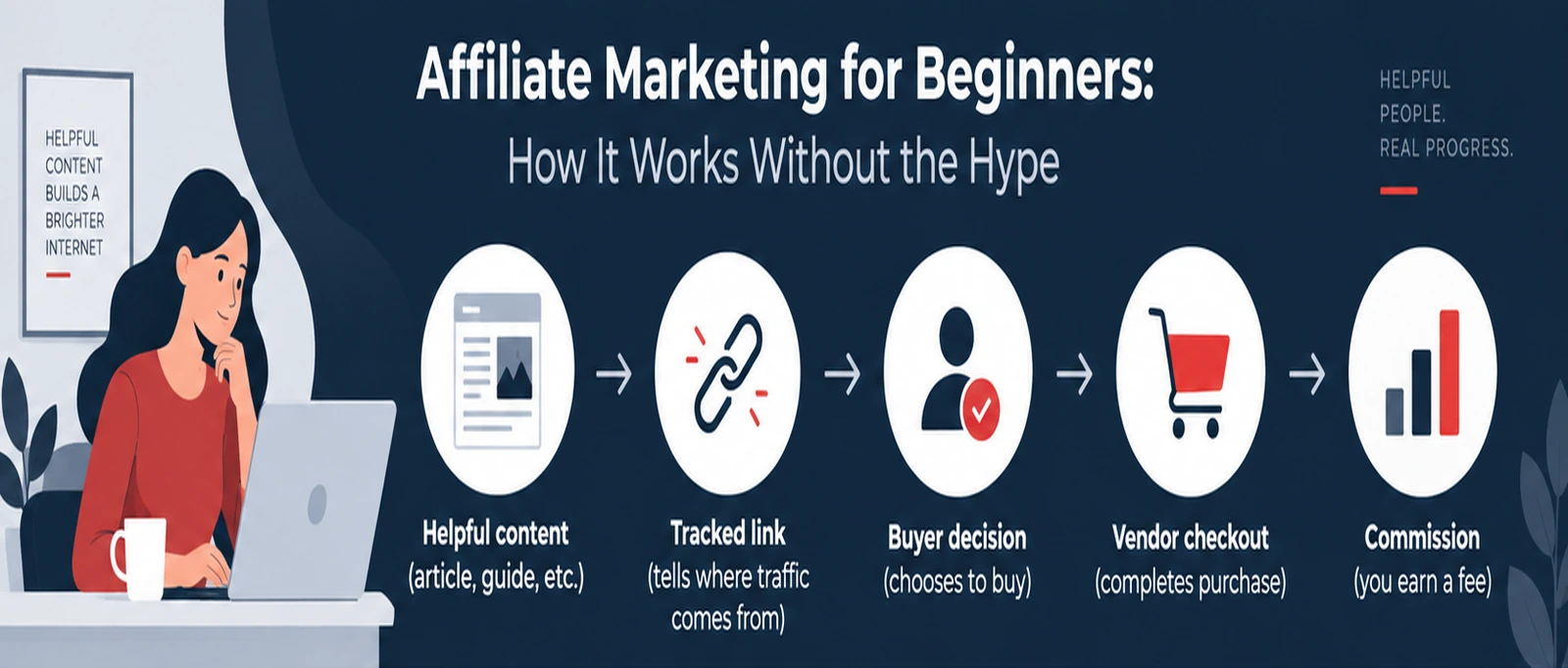
Affiliate marketing works through a tracked recommendation path. The affiliate sends a visitor through a unique link, and the platform records whether that visitor takes the commissionable action.
A simple version looks like this:
- The affiliate joins a program or gets approved to promote an offer.
- The platform gives the affiliate a unique tracking link.
- The affiliate creates content that explains or recommends the offer.
- A reader clicks the affiliate link.
- The reader decides whether to buy.
- The platform records the sale if the tracking works and the sale qualifies.
- The affiliate may receive a commission after any approval, refund, or payout period.
Platforms can vary. Some programs are run by large retailers. Some are run by software companies. Some use affiliate networks. Some digital-product marketplaces use approval systems where vendors choose which affiliates can promote each offer.
For example, WarriorPlus documentation describes an affiliate link as a unique URL assigned to an affiliate to track traffic and sales. That definition is simple, but the business decision behind the link is where affiliates need judgment.
How do affiliates actually make money?
Affiliates make money only when the program's commission conditions are met. The common version is a sale, but some programs may pay for leads, trials, sign-ups, calls, or recurring subscriptions.
The commission is not the same as profit. An affiliate may spend time, software costs, ad costs, email platform fees, hosting costs, design costs, or content production costs before any commission appears. That is why realistic affiliate marketing starts with economics, not excitement.
Key numbers include:
- Commission amount or percentage.
- Refund rate or cancellation risk.
- Conversion rate from click to sale.
- Traffic source cost.
- Email list cost.
- Content production time.
- Support load from people who ask you questions after buying.
A product with a high commission can still be a poor promotion if the product is weak, the refund rate is high, the support is poor, or the audience fit is wrong. A product with a lower commission can be better if it solves a real problem and creates fewer buyer issues.
This is why Marketing Review Lab treats commission as one factor, not the main reason to promote.
Is affiliate marketing worth it for beginners?
Affiliate marketing can be worth learning, but beginners should treat it as a skill-building business model rather than a quick-income plan. It rewards trust, audience fit, useful content, and consistent follow-up.
A beginner usually needs to learn several skills at once:
- Choosing offers that fit a real audience.
- Writing honest reviews or tutorials.
- Building a simple website or content hub.
- Creating a capture page or email follow-up path.
- Disclosing affiliate relationships clearly.
- Tracking which content gets clicks and which offers create buyer value.
The mistake is trying to promote everything. Beginners often join too many programs, chase every launch, copy vendor claims, and build no durable audience of their own. That creates motion without trust.
A better starting point is one niche, one type of buyer, one content format, and a short list of products you can explain without exaggerating.
What does an affiliate need before promoting an offer?
An affiliate needs more than a link. A responsible affiliate needs a reason to recommend the product, a clear disclosure, and enough context to help the buyer decide.
Before promoting an offer, ask:
- What exact problem does this product solve?
- Who is it for?
- Who should skip it?
- What hidden costs or dependencies exist?
- What claims need proof?
- What refund and support terms apply?
- Would I be comfortable explaining this recommendation after someone buys?
Those questions overlap with the Marketing Review Lab evaluation checklist. That is intentional. The same checks that protect buyers also protect affiliates from promoting offers that create complaints, refunds, and trust damage.
Why does disclosure matter in affiliate marketing?
Disclosure matters because readers deserve to know when a recommendation can financially benefit the person making it. It also keeps the affiliate relationship honest from the beginning.
The FTC's endorsement guidance says endorsements should be honest and not misleading. It also explains that a connection between an endorser and marketer should be disclosed clearly when consumers would not expect it and when it could affect how they evaluate the endorsement.
For affiliate marketing, that means a disclosure should not be buried in a footer or hidden behind vague language. Readers should see it before or near the recommendation. The point is not to scare people away. The point is to let them weigh the recommendation with full context.
Marketing Review Lab uses an affiliate disclosure at the top of affiliate articles and keeps a dedicated Affiliate Disclosure page for additional context.
What makes affiliate marketing risky?
Affiliate marketing becomes risky when the commission starts driving the recommendation. The risk is highest in niches with urgent promises, income claims, scarcity timers, and low-ticket offers that lead into multiple upsells.
Common risks include:
- Promoting products without reviewing the buyer experience.
- Repeating vendor income claims without proof.
- Sending beginners into tools they are not ready to use.
- Hiding the affiliate relationship.
- Offering bonuses that sound more valuable than the core product.
- Promoting every launch in a marketplace without a clear standard.
- Ignoring refund terms and support quality.
These risks do not mean affiliate marketing is bad. They mean the affiliate needs rules. A buyer-first review site should be willing to say "skip this" when the offer does not fit.
How should buyers read affiliate reviews?
Buyers should read affiliate reviews as decision support, not as automatic proof that the product is right for them. A good review gives you context, tradeoffs, and fit.
When reading a review, look for:
- A visible affiliate disclosure.
- Clear explanation of who the product is for.
- Clear explanation of who should skip it.
- Specific implementation requirements.
- Honest limitations.
- Links to support, refund, or official product information.
- No fake scarcity, fake ratings, fake screenshots, or unsupported income claims.
The Profit Hub System review is a worked example of this buyer-first approach. The review explains who the offer fits, what buyers should check, what support context matters, and how the system fits into an owned-site affiliate strategy.
Browse the Marketing Review Lab reviews for more worked examples.
What is the realistic affiliate marketing workflow?
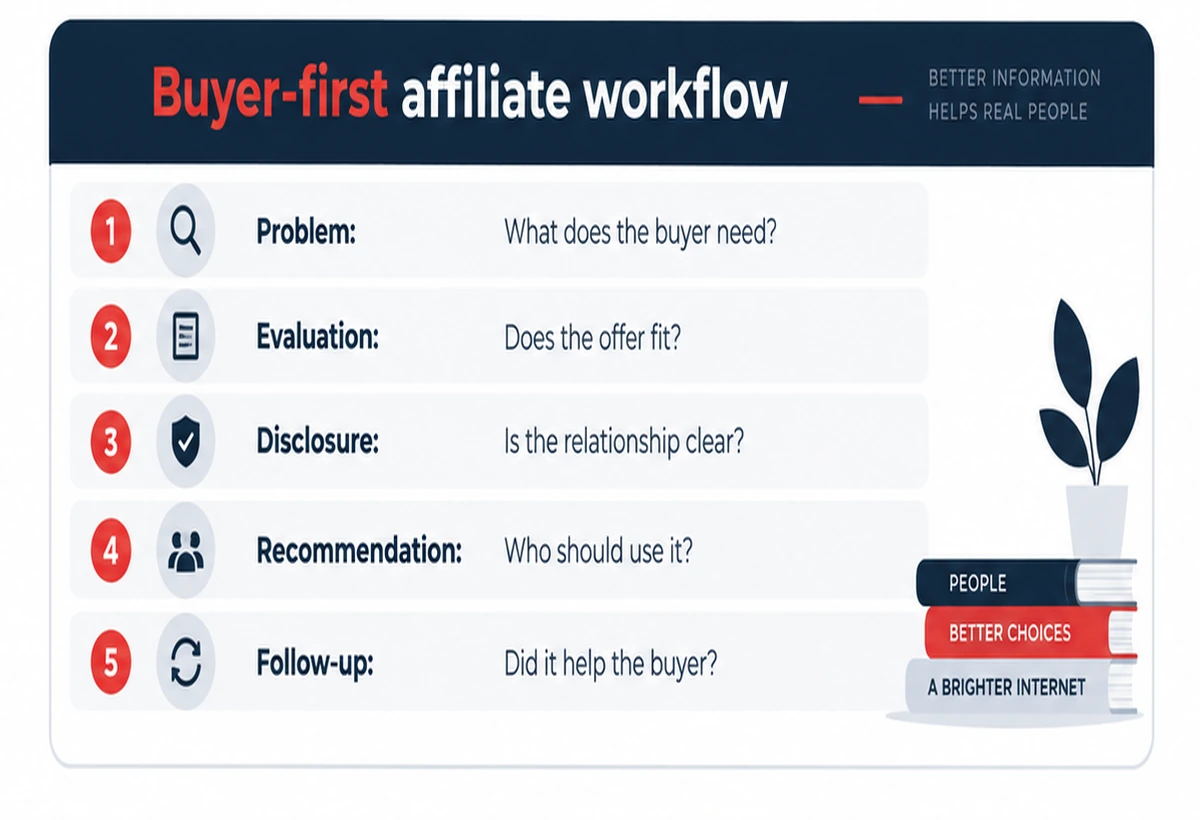
A realistic affiliate marketing workflow starts with the audience and the problem, then works backward to the offer. It does not start with the highest commission.
A simple workflow looks like this:
- Pick a buyer problem you understand.
- Find products that claim to solve that problem.
- Run each product through an evaluation checklist.
- Create useful content around the decision.
- Add clear disclosure and honest links.
- Build a follow-up path for readers who want more help.
- Review results, refunds, questions, and buyer feedback.
- Stop promoting offers that do not hold up.
This is slower than copying launch emails, but it builds an asset. A review, tutorial, comparison, or email sequence can keep helping readers long after the launch window closes.
Where do WarriorPlus and launch marketplaces fit?
WarriorPlus and similar marketplaces are platforms where vendors, affiliates, and buyers meet around digital products. They can be useful, but they do not remove the need to evaluate each offer.
A marketplace can make tracking, checkout, delivery, and affiliate links easier. It does not guarantee product quality. Buyers still need to inspect the offer. Affiliates still need to decide whether they should recommend it.
Read the WarriorPlus review for a deeper explanation of how that marketplace works and what buyers should check before purchasing or promoting an offer.
Want to see affiliate marketing applied to a real offer?
Start with the Profit Hub System review. It shows how Marketing Review Lab applies a buyer-first review process to a real affiliate-marketing offer, including fit, support context, bonus considerations, and practical buyer checks.
Final verdict: affiliate marketing for beginners works best when it starts with trust
Affiliate marketing works best when it helps the buyer first. The affiliate earns by connecting the right person to the right product with clear expectations and honest disclosure.
The weak version chases commissions and repeats sales-page claims. The stronger version builds trust, explains tradeoffs, and treats every recommendation as something that can affect a real person's time and money.
For Marketing Review Lab, that is the standard. Affiliate marketing is not the problem. Lazy promotion is the problem. The goal is to review, explain, and recommend with enough context that the buyer can make a better decision.
FAQ
How does affiliate marketing work in simple terms?
Affiliate marketing works by using tracked links. If someone clicks an affiliate's unique link and completes a qualifying action, the affiliate may earn a commission.
Do affiliates own the products they promote?
Usually, no. Affiliates usually recommend or explain products made by vendors, merchants, or software companies. The vendor handles the product, checkout, delivery, and support.
Can beginners make money with affiliate marketing?
Beginners can learn affiliate marketing, but there is no guaranteed income. Results depend on audience fit, offer quality, trust, content, traffic, follow-up, costs, and consistency.
Do affiliate links need a disclosure?
Yes, affiliate relationships should be disclosed clearly when the affiliate may earn from a recommendation. Readers should understand the relationship before they rely on the recommendation.
What is the safest way to start affiliate marketing?
Start with one audience, one problem, and a small set of products you can explain honestly. Learn the buyer problem first, then choose offers that fit that problem.
For more questions, visit the Marketing Review Lab FAQ.
\n\n




0 Comments