
This post contains affiliate links. If you purchase through these links, we may earn a commission at no additional cost to you.
For email compliance basics, see the FTC CAN-SPAM compliance guide and Google's email sender guidelines.
Table of Contents
TL;DR
Affiliate email marketing works when you collect permission, set clear expectations, send useful follow-up, and recommend offers that fit the reader's problem. The list is not just a place to drop affiliate links. It is a trust asset.
- Build a list around a specific buyer problem, not a random collection of subscribers.
- Use a clear opt-in promise so people know why they are joining.
- Send helpful follow-up before and between promotions.
- Make unsubscribe easy and honor the reader's inbox.
- Promote fewer offers and explain who each offer fits.
Affiliate marketers often hear that "the money is in the list." That phrase leaves out the part that matters. The value is in the relationship with the list.
A list of people who do not remember joining, do not trust your recommendations, or only hear from you during product launches is not much of an asset. A smaller list that understands your promise and gets useful help can be far more valuable.
This guide explains email list building for affiliate marketers in a practical way. It covers what to collect, what to send, how to stay useful, where compliance fits, and how a list supports honest product reviews.
What is affiliate email marketing?
Affiliate email marketing is the process of inviting people to join your email list because they want help with a specific problem, then using email to educate, follow up, and occasionally recommend relevant offers.
The list gives you a direct way to reach readers after they leave your site, video, ad, or social post. That matters because most people do not buy the first time they see an offer. They compare, wait, forget, ask questions, and come back later.
A useful affiliate list usually has three parts:
- A clear opt-in reason.
- A helpful follow-up sequence.
- A promotion standard that protects trust.
The opt-in reason might be a checklist, short training, buyer guide, bonus notification, review updates, or practical email course. The follow-up sequence helps the subscriber solve the problem that brought them in. The promotion standard decides what you will and will not recommend.
Why do affiliates need an email list?
Affiliates need an email list because rented attention is fragile. Search rankings change, social platforms shift, ad costs rise, and product launches come and go.
An email list gives you a way to keep helping people after the first visit. It also helps you stop treating every page view as a one-time chance to earn a commission.
For an affiliate review site, an email list can support:
- New review announcements.
- Product launch reminders.
- Buyer checklists.
- Bonus claim instructions.
- Follow-up lessons after someone joins through your link.
- Warnings about offers that do not meet your standards.
- Updates when a product changes pricing, support, or access.
The list is not a replacement for good content. It extends good content. If the website helps people decide, the list helps them stay on track.
What should you offer to get subscribers?
Offer something that helps the reader make a better decision or take the next step. The best lead magnet is closely tied to the problem your content already solves.
For affiliate marketing, useful opt-in offers include:
- A buyer checklist.
- A product comparison worksheet.
- A launch evaluation checklist.
- A beginner setup checklist.
- A short email course.
- A bonus claim guide for a specific offer.
- A weekly review digest.
Avoid vague promises like "get my secret system" unless the content is truly specific and useful. A strong opt-in promise tells the reader what they will get and why it matters.
For example, a visitor reading the WarriorPlus review might want a checklist for evaluating marketplace offers. A visitor reading the affiliate marketing for beginners guide might want a practical next step. A visitor reading the Profit Hub System review might want help understanding what to set up after joining.
The opt-in should match the page. If the page is about evaluating software, offer an evaluation tool. If the page is about building a funnel, offer a funnel checklist. If the page is a product review, offer buyer support that relates to that product.
What should an affiliate email sequence include?
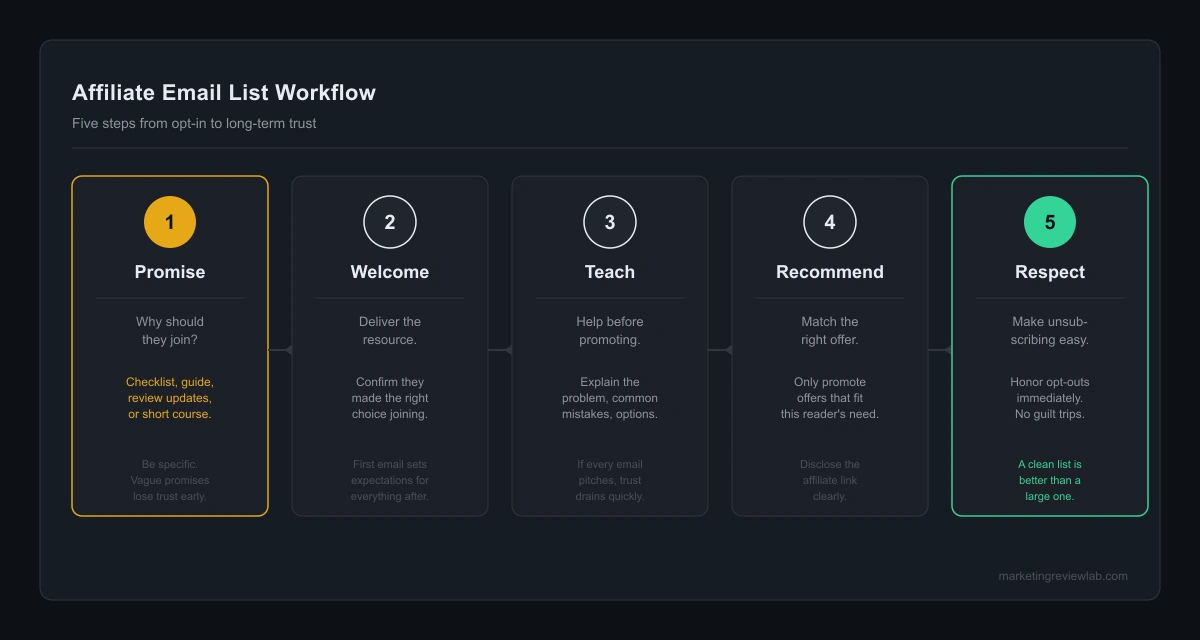
An affiliate email sequence should help the subscriber solve the problem they joined for before it asks for a sale. Promotions can fit, but they should not be the only reason the sequence exists.
A simple five-email structure can work:
- Welcome and deliver the promised resource.
- Explain the main mistake people make with this problem.
- Teach a simple framework or checklist.
- Show how to compare options or avoid bad-fit offers.
- Recommend a product only if it fits the reader's problem.
For product-specific follow-up, the sequence can be more direct. If someone joins from a review page, they may want implementation notes, bonus instructions, or a reminder of who the product fits and who should skip it.
The key is expectation. If the opt-in says the reader will get product review updates, review updates are fine. If the opt-in says they will get a tutorial, send the tutorial before turning the sequence into promotions.
How often should affiliate marketers email their list?
Affiliate marketers should email often enough to stay familiar and useful, but not so often that every message feels like a pitch. The right frequency depends on the promise people joined for.
A review digest might be weekly. A short training sequence might be daily for a few days. Product launch reminders might cluster around a launch window. Long-term newsletter content might be one to three times per week.
The more promotional the list is, the more careful you need to be. If subscribers only hear from you when there is a commission opportunity, trust will fade. If they hear from you with useful examples, checklists, lessons, and honest reviews, promotions make more sense.
A good test is simple: would this email still be useful if the reader does not buy today? If the answer is yes, the message is probably doing more than selling.
What compliance basics should affiliate marketers know?
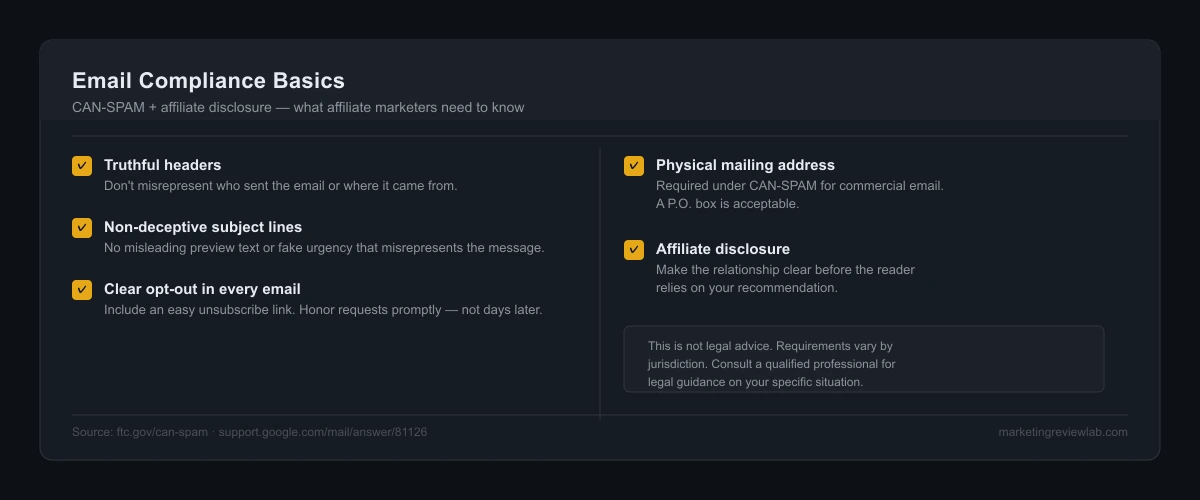
Affiliate marketers should treat email compliance as part of list building, not a technical afterthought. Email rules and sender requirements protect subscribers and help legitimate senders keep access to inboxes.
The FTC's CAN-SPAM guide explains core rules for commercial email, including truthful header information, non-deceptive subject lines, identifying advertising where required, including a valid physical postal address, telling recipients how to opt out, honoring opt-out requests promptly, and monitoring what others do on your behalf.
Google's sender guidelines also matter because many subscribers use Gmail. Google requires senders to authenticate outgoing email, avoid unwanted mail, and make it easy for recipients to unsubscribe. Bulk senders have additional requirements.
This is not legal advice. It is the practical point for affiliate marketers: do not hide who you are, do not mislead people into opening messages, and do not make unsubscribing difficult.
What tools do you need to build an email list?
You need a way to collect subscribers, store them, send email, manage unsubscribes, and track basic results. You do not need a complicated stack to start.
A simple stack can include:
- A website or landing page.
- An email service provider.
- A form or capture page.
- A thank-you page.
- A welcome email.
- A short follow-up sequence.
- Basic link tracking.
Before buying another tool, use the Marketing Review Lab evaluation checklist. Ask whether the tool solves a current problem, replaces something you already pay for, has realistic claims, includes hidden costs, and is something you will actually use.
If your current website builder or email platform already provides forms, landing pages, and automation, start there. Add tools only when the missing capability is real.
How does email support affiliate reviews?
Email supports affiliate reviews by continuing the conversation after the first review page. A review helps someone decide. Email helps them remember, compare, ask, and implement.
For a buyer-first review site, email can add:
- A reminder to read the full review before buying.
- A checklist for evaluating the offer.
- A link to related reviews.
- Clarification on bonuses and support.
- Follow-up after purchase.
- Warnings when an offer is not a fit.
The Profit Hub System review is a good example of a page where follow-up can matter. The decision is not just whether to buy. The buyer may also need to understand setup, traffic, lead capture, and realistic implementation.
Email lets a site support those steps without making the review itself too long or too promotional.
What mistakes should affiliate marketers avoid?
Affiliate marketers should avoid list-building habits that trade long-term trust for short-term clicks. The common mistakes are usually simple.
Avoid:
- Buying email lists.
- Adding people who did not ask to hear from you.
- Sending only launch promotions.
- Hiding affiliate relationships.
- Using misleading subject lines.
- Making unsubscribes hard.
- Promoting products you have not evaluated.
- Over-promising results to get clicks.
- Ignoring refund, support, and buyer complaints.
Every email teaches subscribers what to expect from you. If you teach them that your emails are useful, they keep opening. If you teach them that every email is just a commission pitch, they stop trusting the list.
Want to see list building connected to a real offer?
Start with the Profit Hub System review. It explains how an affiliate-focused product fits into owned-site traffic, lead capture, list growth, and follow-up. Use that review as a real example of how Marketing Review Lab connects a product decision to the broader system around it.
Final verdict: what actually works for affiliate email lists?
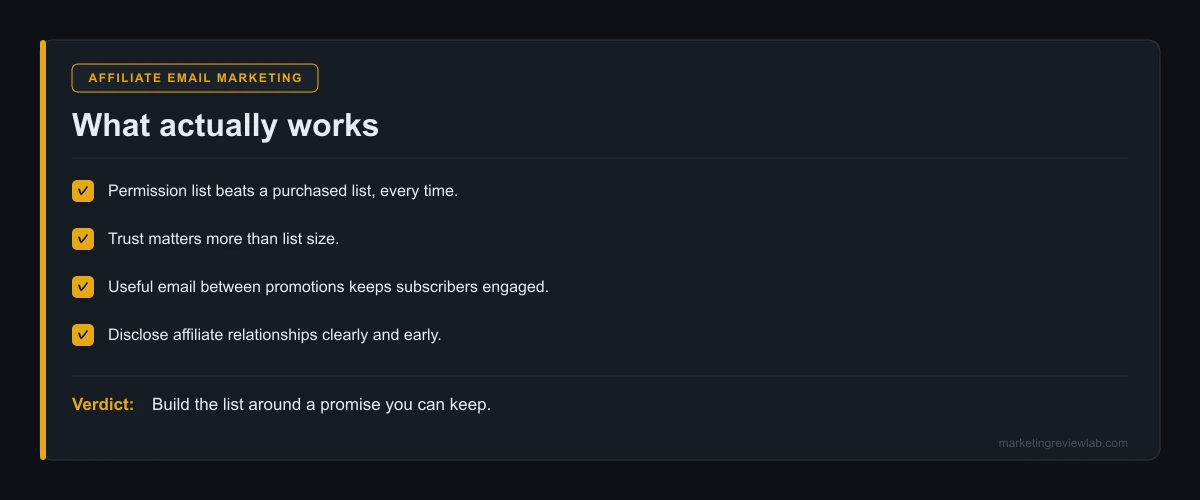
Email list building works for affiliate marketing when the list is built around a clear promise and maintained with useful follow-up. It fails when the list becomes a place to send every offer with the highest commission.
The realistic path is simple, but not effortless. Pick a buyer problem. Offer a useful reason to subscribe. Send practical help. Disclose affiliate relationships. Recommend selectively. Track what happens. Stop promoting offers that do not serve the reader.
That is the version of email list building that fits Marketing Review Lab. Browse the Marketing Review Lab reviews for worked examples of how product evaluations connect to the reader's actual problem. For more questions, visit the Marketing Review Lab FAQ.
FAQ
Do affiliate marketers need an email list?
Affiliate marketers do not always need an email list to start, but a list helps build a durable audience and follow-up path. It is especially useful for reviews, launches, bonuses, and education.
What should I send after someone joins my affiliate list?
Send the resource they requested first. Then send useful follow-up that explains the problem, teaches a framework, compares options, and recommends products only when they fit.
Can I promote affiliate links in email?
Yes, if your email platform allows it and you follow the relevant rules, disclosures, and platform policies. Make the affiliate relationship clear and avoid misleading claims.
How many emails should be in an affiliate follow-up sequence?
A simple sequence can start with five emails: deliver the resource, explain the main mistake, teach a framework, compare options, and make a fit-based recommendation. Add more only when the reader needs more help.
What is the biggest mistake in affiliate email marketing?
The biggest mistake is treating the list as a place to send every promotion. A list works better when subscribers get useful help between offers and trust the recommendations you make.





0 Comments