

-->
Affiliate disclosure: This page contains affiliate links. If you buy through them, we may earn a commission at no extra cost to you. See our affiliate disclosure for details.
TL;DR: Affiliate marketing is a real business model. It is also one of the most aggressively oversold niches on the internet. The gap between how it is promoted and how it actually works is where most people get burned. This guide covers what affiliate marketing without hype genuinely requires, what the income screenshot culture is hiding from you, and what a no-hype starting point actually looks like.
Table of Contents
What affiliate marketing is, without the pitch
Affiliate marketing is straightforward: you promote someone else's product using a unique referral link, and when someone buys through that link, you earn a commission.
That is the whole model. No inventory, no customer service, no product creation. You are a referral source, and you get paid for qualified referrals.
The reason it attracts so much hype is that the ceiling is genuinely high. A well-positioned affiliate with a real audience and the right offers can earn significant income. That part is true.
What the hype leaves out is the floor — the work, the time, the failed attempts, and the infrastructure required before any of that ceiling is reachable. Affiliate marketing without hype starts with being honest about that floor.
The income screenshot problem
The most common marketing tactic in the affiliate space is the income screenshot: a PayPal balance, a WarriorPlus dashboard, a ClickBank earnings graph. Usually displayed prominently on a sales page, often with a timestamp showing the results from the last 24 or 48 hours.
Here is what those screenshots do not tell you:
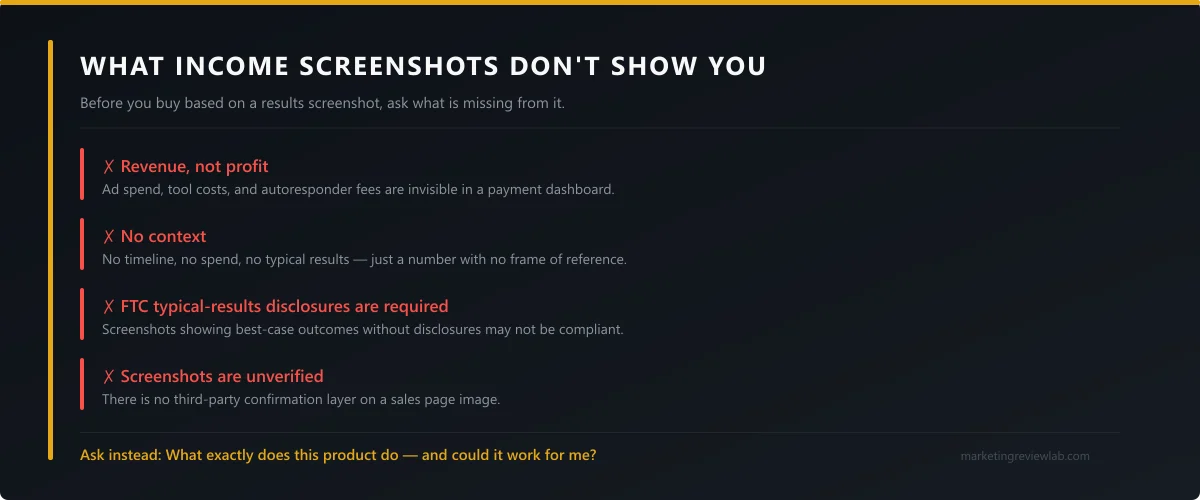
- They show revenue, not profit. Ad spend, tool costs, and autoresponder fees are not visible in a payment dashboard.
- They show a single account at a single moment. There is no context about what was spent to generate those results, how long it took to build to that point, or whether those results are typical.
- The FTC requires income disclosures that reflect what typical buyers actually experience — not the best-case result. A screenshot without a typical-results disclosure is not just misleading, it may be non-compliant.
- Screenshots are easy to fabricate. There is no verification layer on a sales page image.
This is not a claim that every vendor who shows income screenshots is dishonest. Some are legitimate and simply following a promotional norm in the space. But the norm itself is a problem, because it trains buyers to evaluate products based on aspirational outcomes rather than actual deliverables.
The question to ask is not "how much did this person make?" It is "what exactly does this product do, and could it plausibly produce results for me?"
What affiliate marketing actually requires
There is no universal timeline or income guarantee in affiliate marketing. What there is, consistently, is a set of components that have to be in place before results are possible.
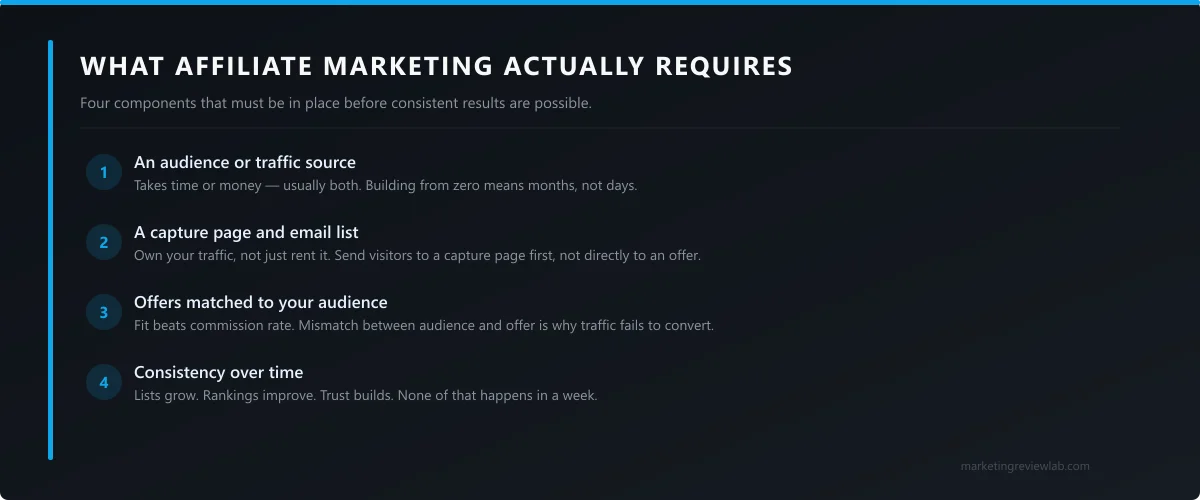
An audience or a traffic source
You need people to see your offer. This can come from organic search, social media, email, paid ads, or channels like safelists. None of these are instant, and most require either time or money — usually both.
A beginner starting from zero has no list, no search rankings, no social following. Building any of those to the point where they produce consistent traffic takes months, not days.
A capture page and a list
Sending traffic directly to an affiliate sales page is one of the least efficient approaches in the space. You have no control over the follow-up, no way to reach that visitor again if they do not buy immediately, and no asset to show for the traffic you paid for.
A capture page collects the visitor's email address first. Once they are on your list, you can follow up over time, build trust, and present your offer more than once. This is the difference between renting attention and owning it.
Offers that match the audience
The best traffic in the world does not convert if the offer is wrong for the audience. An email list built around internet marketing tools needs offers relevant to internet marketers. A list built around a fitness topic needs fitness offers.
Mismatch between audience and offer is one of the most common reasons affiliates see traffic but no conversions.
Consistency over time
Affiliate marketing compounds. A list grows. Search rankings improve with more content. A relationship with an audience deepens over multiple emails. None of that happens in a week.
The hype sells the idea of fast results because fast results are what people want to buy. The reality is a business model that rewards consistent, patient effort — which is less exciting to put on a sales page, but more useful to know going in.
What "no hype" affiliate marketing looks like in practice
Practicing affiliate marketing without hype means building the real infrastructure instead of chasing shortcuts. A realistic setup has these characteristics:
- A specific audience — not "everyone who wants to make money online," but a defined group with a defined problem
- A capture page that collects email addresses before sending visitors anywhere
- An email sequence that builds familiarity and delivers value before making the primary ask
- Offers selected for fit, not just commission rate
- A traffic plan — at least one channel being built consistently, whether that is content, email, paid, or another source
- Honest promotion — describing what a product does and who it is for, without income claims that cannot be substantiated
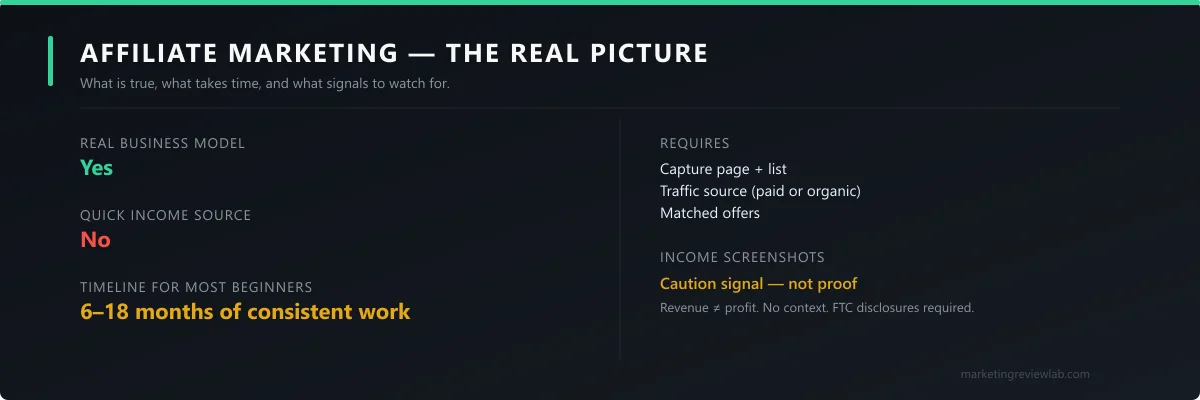
This is not complicated. It is also not a weekend project. Most people who succeed at affiliate marketing spent 6 to 18 months building these pieces before seeing consistent results.
A no-hype starting point
If you are new to affiliate marketing without hype and want to build a real foundation rather than chase a shortcut, the starting point is the infrastructure: a capture page, a basic email sequence, and a list-building system.
The Profit Hub System is one option worth looking at for exactly this reason. It does not promise income. It provides a site template, a capture page setup, a 7-day follow-up email sequence, and guidance on getting your list import into LeadsLeap — the functional pieces of a beginner affiliate setup. No income screenshots on the sales page. No "results not typical" disclaimers hiding implausible claims.
It is not the only option, and it is not right for everyone. But it passes the basic evaluation: specific deliverables, honest positioning, and a mechanism that could plausibly produce results for someone starting from scratch.
For a fuller framework for evaluating any affiliate offer before you buy, see the WarriorPlus product evaluation guide — the same five checks apply to any product in this space.
Frequently asked questions
Is affiliate marketing actually profitable?
It can be. It is a legitimate business model that works for people who build real audiences, select relevant offers, and treat it as a long-term business rather than a quick income source. It is also an industry with a high failure rate among people who buy into the hype version and expect fast results without the infrastructure work.
How long does it take to make money with affiliate marketing?
There is no honest universal answer. Someone with an existing audience and relevant offers can see results quickly. Someone starting from zero — no list, no traffic, no content — is typically looking at months of consistent work before seeing meaningful results. Any source that promises a specific timeline should be evaluated carefully.
Do I need a website to do affiliate marketing?
No, but you need a capture page. The distinction matters: a full website with content takes time to build and rank. A single focused capture page that collects email addresses can be set up quickly and is the minimum viable infrastructure for building a list. Most successful affiliates eventually have both.
What makes an affiliate offer worth promoting?
Specific deliverables you can describe clearly, honest positioning without unsubstantiated income claims, a refund policy that does not require you to prove you tried and failed, and relevance to your actual audience. Commission rate is a secondary consideration — a 50% commission on a product that does not convert for your audience is worth less than a 20% commission on something your list actually wants.
Why do so many affiliate marketing courses use income screenshots?
Because they work as a marketing tactic. Screenshots of high earnings trigger aspiration and reduce the rational evaluation of whether the product can actually deliver results. It is a proven conversion technique in the IM space, which is exactly why it should be a caution signal rather than a selling point when you see it.





0 Comments