

Affiliate disclosure: This page contains affiliate links. If you buy through them, we may earn a commission at no extra cost to you. See our affiliate disclosure for details.
TL;DR
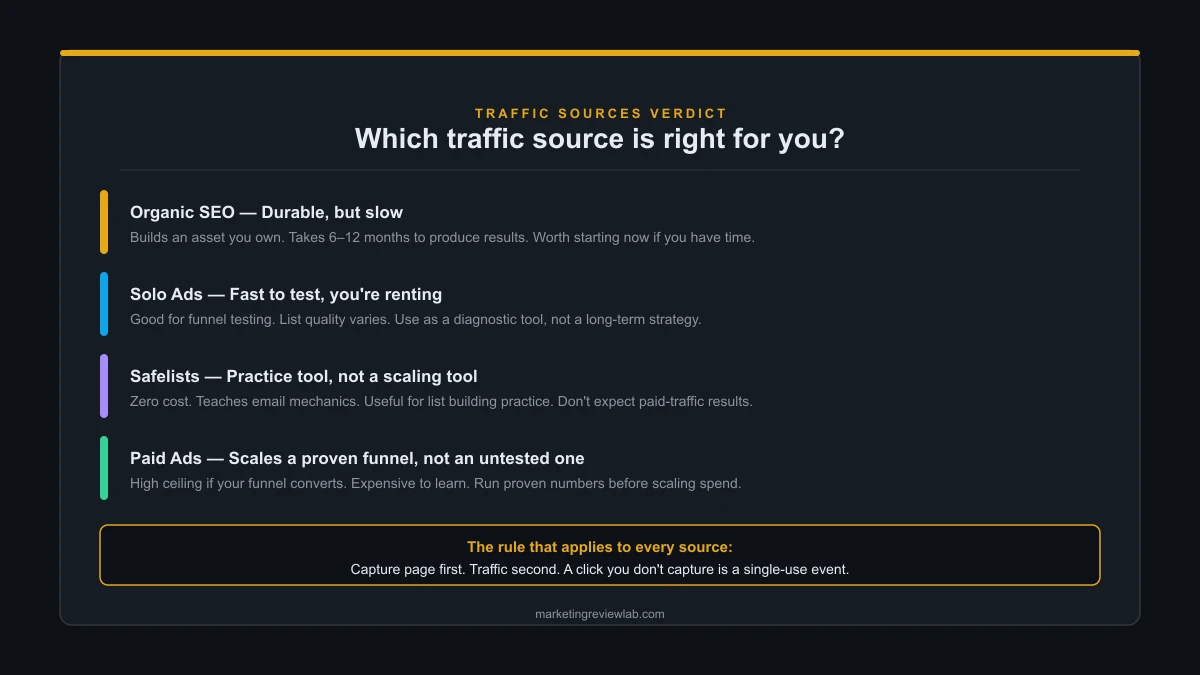
There is no single best traffic source for affiliate marketing. The right one depends on your budget, how fast you want to see results, and what you are building long-term. Organic search is the slowest but most durable. Solo ads are fast to test but you are renting an audience you do not own. Safelists cost almost nothing and teach you email mechanics. Paid social and paid search can scale, but they are expensive to learn. The one thing all of them share: traffic without a capture page means you are building nothing lasting.
Table of Contents
What is the actual goal of affiliate traffic?
Most guides frame this as "how to get clicks." That is the wrong question.
The goal of affiliate traffic is to build an audience you can reach again. A click that does not convert and is not captured in a list is just a single use event. You spent time or money to get it and have nothing to show after.
Before you choose a traffic source, decide what you want to build: a list, a following, an authority site, or a combination. The answer changes which traffic source makes sense and how you should measure results.
The short version: if you are doing affiliate marketing without some kind of email capture in your funnel, you are doing the hard work twice on every campaign.
What are the main traffic sources for affiliate marketing?
These are the categories worth understanding. Each has a different cost structure, time investment, and tradeoff.
| Traffic source | Cost | Speed | Ownership | Best for |
|---|---|---|---|---|
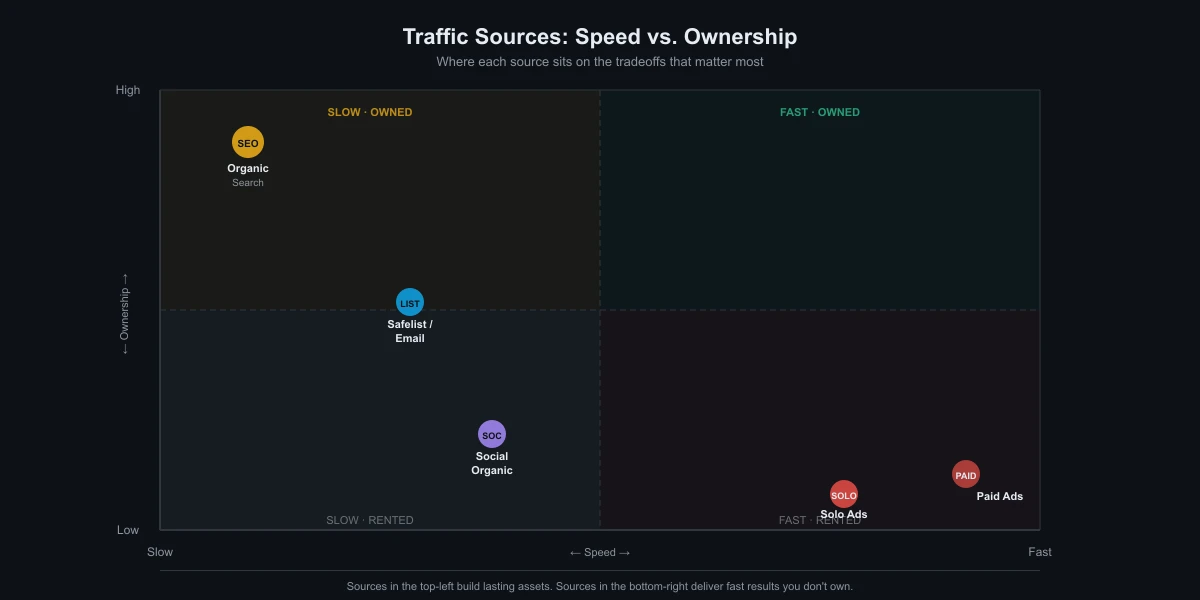
| Organic search (SEO) | Time | Slow (months) | High | Long-term asset building |
| Email/safelist marketing | Time or low cash | Medium | Medium | List growth practice, zero-budget testing |
| Solo ads | Cash | Fast (days) | Low (rented) | Fast funnel testing |
| Social organic | Time | Medium | Low | Building an audience on a platform you do not control |
| Paid search/social | Cash | Fast | Low (rented) | Scaling a proven funnel |
The ownership column matters more than most people consider when starting out. Organic and email traffic builds assets you keep. Paid and platform traffic stops the moment you stop paying or the algorithm changes.
Does free traffic for affiliate marketing actually work?
Free traffic works, but the word "free" is misleading. You are paying with time instead of money, and time has an opportunity cost too.
The two main free traffic paths for affiliate marketers are organic search (SEO) and social organic posting. Both require consistent effort over months before they produce reliable results.
What works about free traffic
- Once established, it can run with lower ongoing effort than paid traffic.
- Organic search traffic tends to have clearer commercial intent, because the person searched for something specific.
- A content site built on SEO is an asset with real value over time.
What does not work about it
- It is slow. New sites typically take six to twelve months to rank for meaningful search terms.
- It requires skills that take time to develop, including keyword research, writing, and technical SEO basics.
- Social platforms change their algorithms, and organic reach on most platforms has declined significantly over the last few years.
If you are starting with no budget and cannot afford paid traffic, organic content is worth building. Do not expect results in the first few months. If you need faster feedback on a funnel, organic search alone is too slow.
Are solo ads worth using for affiliate marketing?
Solo ads can be worth using if you need fast data on a funnel and you are realistic about what you are buying.
A solo ad is a paid email broadcast to someone else's list. You pay per click. The list owner sends your offer to their subscribers. If your offer and funnel are solid, you can get opt-ins and sales quickly.
The case for solo ads
- You can get several hundred clicks in 48 to 72 hours.
- This is useful when you want to test whether a landing page converts before investing in SEO or paid search.
- Good vendors specialize in specific niches, so targeting is possible.
The honest tradeoffs
- You are renting traffic. When you stop paying, it stops. You are not building your own audience.
- List quality varies significantly between vendors. Some lists are oversold and produce low engagement.
- The affiliate marketing and make-money-online niches are crowded in the solo ad market, and buyers are often on many lists simultaneously.
- Cost per click typically runs $0.35 to $0.70 at lower-to-mid quality. Higher-quality vendors charge more.
The right way to use solo ads is as a testing tool, not a long-term traffic strategy. Test a funnel with a small order, measure opt-in rate and cost per lead, and use that data to decide whether to continue or pivot. Do not use them as a substitute for building an email list you own.
If you want to find vendors, Udimi is the most established solo ad marketplace — you can filter by niche, view verified buyer ratings, and order with a minimum spend to test before committing more. Traffic Zest is a credit-based alternative that can reduce upfront risk for smaller tests.
What about safelist marketing?
Safelists are email marketing platforms where members agree to receive each other's emails in exchange for the ability to send their own. Credits are earned by reading emails, which are then spent to broadcast to other members.
This sounds circular because it is, to an extent. Safelist traffic is generally low in commercial intent and conversion rates are modest. But safelists are genuinely useful for specific situations.
Where safelists add value
- Zero cash outlay. If you are starting with no budget, safelists give you a place to practice writing email subject lines, testing offers, and understanding email mechanics.
- You can build a small list using a safelist because some members do opt in to capture pages.
- The email frequency disciplines you to think about open rates and subject lines, which carries over to other email work.
What to be realistic about
- Most members are in viewing mode to earn credits, not buying mode. Conversion to cash sales is lower than other traffic sources.
- Volume requires consistent daily effort to earn and spend credits.
- Safelist traffic is not a replacement for building an owned list through higher-quality sources.
If you are already using safelists as part of your traffic mix, they can contribute to list growth and keep your messaging sharp without additional cost. Do not start with them expecting results equivalent to targeted paid traffic.
How do you choose the right traffic source for your situation?
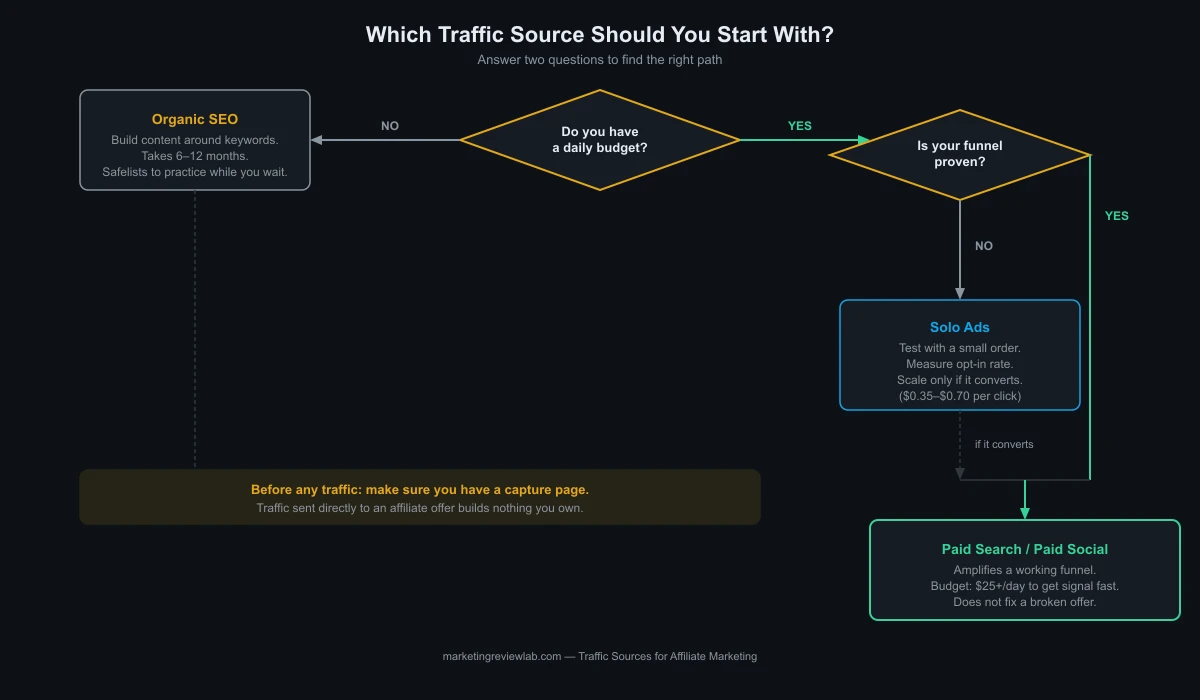
The honest answer depends on three variables: your budget, your time horizon, and what your funnel is ready for.
If you have no budget and a 6-to-12 month runway
Start with organic content. Build around keywords your audience is already searching. Safelists are a low-risk way to practice while organic traffic builds.
If you have a small daily budget ($10 to $25) and want faster feedback
Solo ads are worth testing on a proven or nearly-proven funnel. Keep initial orders small and measure opt-in rate before scaling.
If you have a working funnel with known conversion rates
Paid search or paid social can scale it. The key word is "working." Paid traffic amplifies what is already there, good or bad.
The question to ask before any traffic investment: What happens to the visitor after the click? If the answer is "they see a direct affiliate link and either buy or leave," you are likely wasting most of your investment. A capture page that builds your list turns a one-time visitor into a longer-term relationship.
What should your funnel include before driving traffic?
This is worth covering because the traffic source question assumes your funnel is ready. Many affiliates focus on traffic before they have the basics in place.
At minimum, a working affiliate funnel includes:
- A capture page that collects an email address in exchange for something useful.
- A bridge page that warms the visitor before sending them to the affiliate offer.
- An email follow-up sequence that continues the conversation after the initial click.
If you are not sure how to set this up, the Profit Hub System review covers how one entry-level system approaches the owned-traffic problem: building a site, a capture layer, and a list instead of relying on paid traffic alone.
LeadsLeap is a free-to-start platform that handles landing pages, capture forms, autoresponder, and list management in one place — a practical option if you want to build capture infrastructure without a paid tool to start.
Frequently asked questions
What is the best free traffic source for affiliate marketing?
Organic search is the most durable free traffic source if you are willing to invest six to twelve months in content creation and basic SEO. Social organic (YouTube, short-form video, blog) can work but is harder to sustain as platform algorithms change. Safelists require little to no budget and are useful for list building practice, but expect lower conversion rates than targeted search or email traffic.
How many traffic sources should I use?
Start with one and learn it properly before adding another. The most common mistake is distributing effort across too many sources before any of them is working well. Once you have a traffic source generating consistent leads, adding a second source is worth considering.
Do solo ads still work in 2026?
Solo ads still produce clicks and opt-ins, but list quality and return depend heavily on the vendor and how crowded your niche is. The affiliate marketing and make-money-online space is competitive in the solo ad market. Test with small orders and measure your actual opt-in rate before spending more. Do not use solo ads as a long-term strategy, only as a testing tool.
Is safelist marketing worth the time?
Safelists are worth the time if you have no budget and want to practice email marketing mechanics, test offers, and build a small list gradually. They are not a substitute for higher-converting traffic sources when you are ready to scale.
What is the biggest mistake affiliate marketers make with traffic?
Sending traffic directly to an affiliate offer instead of a capture page. When someone clicks and leaves, that visit is gone forever. When they opt in first, you can follow up over time, which is where most affiliate sales actually happen.


0 Comments