Affiliate disclosure: This page contains affiliate links. If you buy through them, we may earn a commission at no extra cost to you. See our affiliate disclosure for details.
TL;DR
Solo ads for affiliate marketing are one of the fastest ways to get traffic to an affiliate funnel. You pay a vendor to broadcast your offer to their email list, and you get clicks within 24 to 72 hours. The speed is real. So is the risk: list quality varies, results are not guaranteed, and beginners often buy too early with an unready funnel. This guide covers how solo ads work, what you need before you buy, how to find and vet vendors, and how to measure whether the traffic was worth it.
Contents
- What are solo ads for affiliate marketing?
- How does buying a solo ad actually work?
- What should you have in place before buying?
- How do you find and vet a solo ad vendor?
- How do you measure whether a solo ad worked?
- What are the most common solo ad mistakes?
- Are solo ads right for your situation?
- Frequently asked questions
What are solo ads?
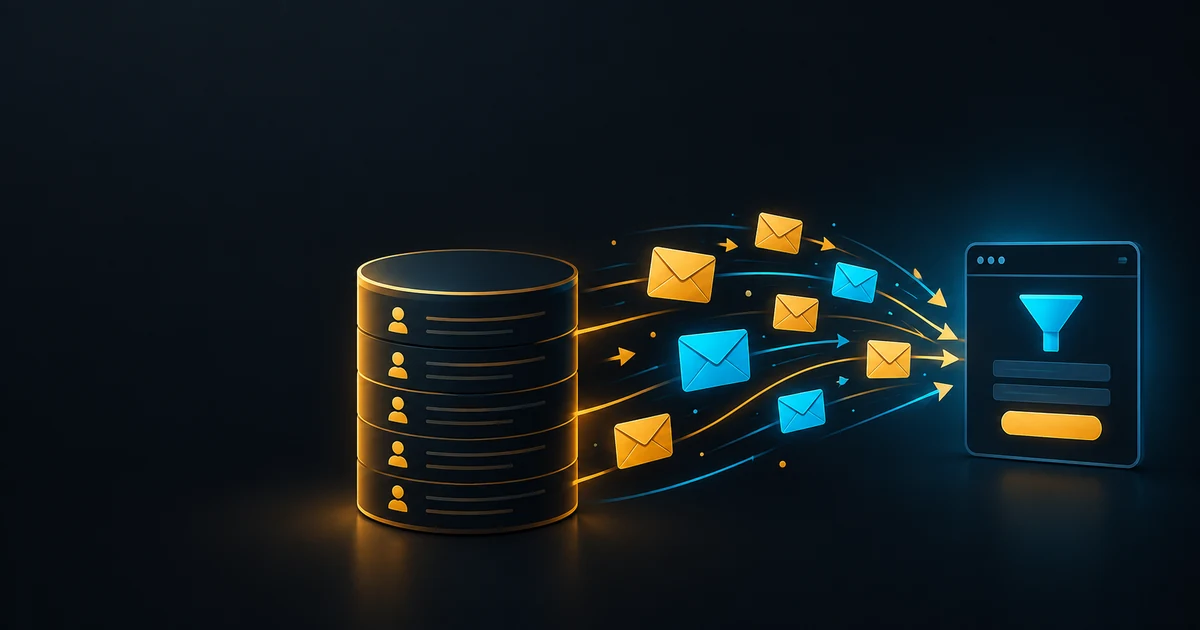
A solo ad is a paid email broadcast. You pay a vendor who has an email list to send your promotional message exclusively to their subscribers. You pay per click. The vendor sends the email, their subscribers click the link, and the traffic lands on your page.
The name comes from the fact that the email is sent on its own — a solo email dedicated to your offer rather than a newsletter with multiple items.
Solo ads are common in the internet marketing, affiliate marketing, and make-money-online niches because those are the audiences where list vendors have built significant subscriber bases. You can find vendors in other niches, but the volume and ecosystem in IM is the largest.
How does buying a solo ad actually work?
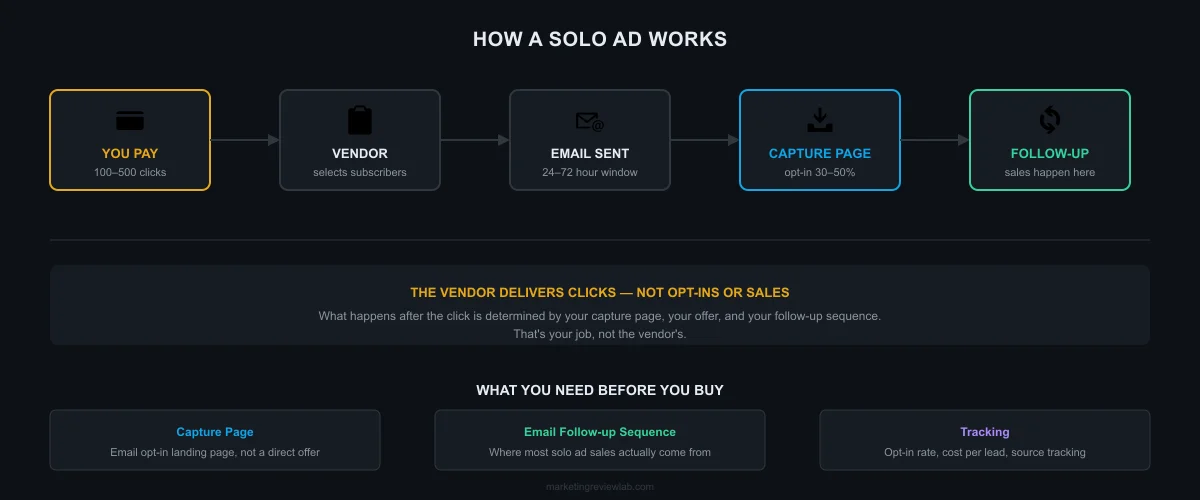
The process is straightforward:
- You choose a vendor whose list matches your offer's niche.
- You agree on a number of clicks (typically 100 to 500 to start).
- You provide your email swipe copy and the URL you want traffic sent to.
- The vendor sends the email to a selection of their subscribers.
- Clicks arrive over the delivery window (usually 24 to 72 hours).
- You track your opt-in rate and any sales during that window.
The vendor delivers clicks, not opt-ins or sales. What happens after the click depends on your landing page, your offer, and your follow-up sequence. That is your job, not the vendor's.
What should you have in place before buying solo ads?
When planning solo ads for affiliate marketing, remember that solo ads are a traffic amplifier. They amplify what is already there — good or bad. Buying solo ads before your funnel is ready is one of the most common ways beginners waste money.
At minimum, you need:
A capture page that converts. Your traffic should land on a page designed to collect email addresses, not on a direct affiliate offer. A capture page that converts at 30 to 50 percent is a reasonable benchmark for solo ad traffic. If you do not have a capture page, set one up first. LeadsLeap is a free-to-start platform that handles landing pages, capture forms, autoresponder, and list management in one place — a practical starting point before committing to paid tools.
A bridge page or follow-up sequence. After opt-in, the visitor should land somewhere that warms them before they see the main offer — a short video, a welcome page, or an email sequence. The sequence is where most solo ad sales actually happen, not on the first click.
Tracking in place. At minimum, you need to know your opt-in rate (opt-ins divided by clicks) and your source. Without tracking, you cannot evaluate the vendor or improve your funnel. Most link trackers and autoresponders handle this.
If you are not sure whether your capture infrastructure is ready, the Profit Hub System review covers one entry-level setup that includes a capture page, bridge page, and 7-day email sequence out of the box.
How do you find and vet a solo ad vendor?
Vendor quality is the main variable in solo ad results. A weak vendor with a burned-out list will deliver clicks that never opt in. A strong vendor with a responsive niche-matched list can produce opt-in rates of 35 to 55 percent.
Three places to find vendors worth testing:
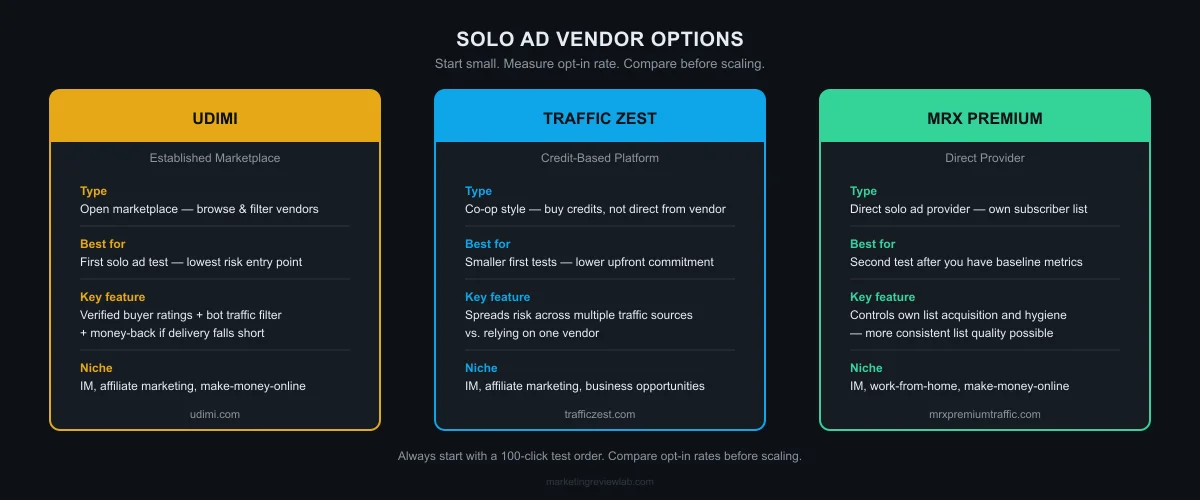
Udimi is the most established solo ad marketplace. You can filter vendors by niche, view verified buyer ratings, see opt-in rate testimonials, and review recent sales statistics. Udimi's buyer-protection system filters bot traffic and provides a money-back mechanism if delivery falls short. It is the lowest-risk starting point for a first solo ad test.
Traffic Zest is a credit-based platform with a co-op style traffic model. You purchase traffic credits rather than buying directly from a named vendor. This can reduce the upfront cost of a first test and spreads risk across multiple sources.
MRX Premium Traffic is a direct solo ad provider operating in the internet marketing and work-from-home space. Direct providers can offer more consistent list quality than open marketplaces because they control their own subscriber acquisition and list hygiene. Worth testing once you have baseline metrics from a marketplace test to compare against.
When vetting any vendor:
- Look for verified buyer reviews with specific opt-in rate data, not just "great traffic" testimonials.
- Ask what niches their list covers and how recently subscribers were acquired.
- Start with a small order (100 clicks) before scaling.
- Avoid vendors who guarantee sales — vendors sell clicks, not conversions.
How do you measure whether a solo ad worked?
A solo ad has worked when the cost per lead is within your acceptable range and the leads are responsive. The click count alone tells you almost nothing useful.
Key metrics to track:
Opt-in rate. Opt-ins divided by clicks. A landing page optimized for solo ad traffic should convert at 30 to 50 percent. Below 25 percent suggests either a weak landing page or poor list match. Above 55 percent suggests unusually strong alignment.
Cost per lead. Total spend divided by total opt-ins. If you paid $80 for 200 clicks and got 70 opt-ins, your cost per lead is $1.14. Whether that is acceptable depends on your offer's conversion rate and average order value.
Email open rate on follow-up. After the initial opt-in period, watch how new subscribers engage with your follow-up emails. Solo ad traffic typically opens at lower rates than organic traffic — 10 to 20 percent on early emails is a reasonable expectation. Significantly lower suggests low-quality subscribers.
Sales (with realistic expectations). Sales from solo ads usually come from the follow-up sequence over days, not from the initial click. Do not judge a solo ad test by day-one sales alone.
What are the most common solo ad mistakes?
Sending traffic directly to an affiliate offer. Without a capture page, every click that does not buy is gone permanently. The capture page turns traffic into a list.
Buying too many clicks before testing. Start with 100 to 200 clicks. Measure opt-in rate. Confirm the vendor's traffic is responsive before scaling to 500 or 1,000 clicks.
Choosing the cheapest vendor. Solo ad pricing in the IM niche typically runs $0.35 to $0.80 per click at legitimate providers. Pricing below $0.25 often signals low-quality or recycled traffic.
Not tracking the source. Use a unique tracking link for each vendor test so you can compare results across vendors and identify which traffic sources produce responsive subscribers.
Expecting fast sales. Solo ad traffic converts over a follow-up sequence, not at first contact. If you do not have an email sequence running, you are leaving most of the value behind.
Are solo ads right for your situation?
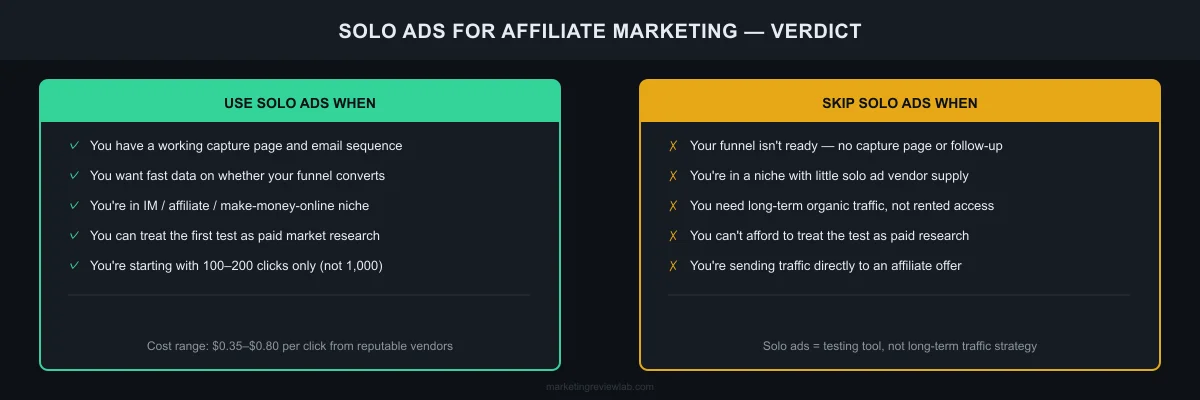
Solo ads make sense when:
- You have a working capture page and follow-up sequence
- You want fast data on whether your funnel converts
- You are in the IM, affiliate marketing, or make-money-online niche where vendor lists are concentrated
- Your budget allows for testing without expecting immediate profit
Solo ads do not make sense when:
- Your funnel is not ready (no capture page, no follow-up)
- You are in a niche with little solo ad vendor supply
- You need to build long-term organic traffic rather than rent audience access
- You cannot afford to treat the first test as paid market research
For a broader comparison of traffic options and how solo ads fit into a full traffic strategy, see the traffic sources for affiliate marketing guide.
Frequently asked questions
What is a solo ad in affiliate marketing?
A solo ad is a paid email broadcast to a vendor's subscriber list. You pay per click. The vendor sends your promotional message to their subscribers, and the traffic lands on your chosen URL. Solo ads are used in affiliate marketing to drive fast traffic to a capture page or offer for funnel testing.
How much do solo ads cost?
Solo ad pricing in the internet marketing niche typically runs $0.35 to $0.80 per click from established vendors. A small test order of 100 clicks costs $35 to $80. Pricing below $0.25 often signals low-quality traffic. Prices vary by vendor reputation, list quality, and niche demand.
Do solo ads actually work for affiliate marketing?
Solo ads produce clicks and opt-ins when the vendor's list matches your offer. They are most effective as a funnel testing tool, not as a long-term traffic strategy. Results depend on landing page quality, offer fit, vendor list quality, and the follow-up sequence. Treat your first test as paid research, not an income event.
What opt-in rate should I expect from solo ads?
A well-matched solo ad to a solid capture page should produce a 30 to 50 percent opt-in rate. Below 25 percent suggests a weak landing page, poor vendor match, or both. Results vary by offer, niche, and list quality.
How do I find good solo ad vendors?
Start with established marketplaces like Udimi, which provides verified buyer ratings and opt-in rate data from previous buyers. Review vendor statistics carefully, look for reviews with specific opt-in rate percentages, and always start with a small test order before committing to larger spends. Direct providers like MRX Premium Traffic are worth testing once you have baseline metrics to compare against.


0 Comments