

Affiliate disclosure: This page contains affiliate links. If you buy through them, we may earn a commission at no extra cost to you. See our affiliate disclosure for details.
TL;DR
These are the affiliate marketing mistakes that keep showing up: most beginners fail for the same reasons: they promote before they understand the product, skip the disclosure, send traffic to an offer with no capture page, and quit before the follow-up sequence has time to work. None of these mistakes are hard to avoid once you know what to watch for. This guide covers the ten most common ones and what to do differently.
Contents
- Why beginners keep repeating the same mistakes
- Mistake 1: Sending traffic directly to an affiliate offer
- Mistake 2: Not building an email list
- Mistake 3: Promoting products without evaluating them
- Mistake 4: Skipping the affiliate disclosure
- Mistake 5: Copying vendor sales page language
- Mistake 6: Joining too many programs
- Mistake 7: Buying traffic before the funnel is ready
- Mistake 8: Promoting every new launch
- Mistake 9: Expecting results in the first week
- Mistake 10: No follow-up after the opt-in
- Frequently asked questions
Why beginners keep repeating the same mistakes
Affiliate marketing has a low barrier to entry. Get a link, share it, earn a commission. That is the version most people encounter first. What gets left out is everything that determines whether the link ever earns anything: audience trust, offer fit, follow-up, and the patience to build something durable.
The mistakes below are not unusual. They follow a predictable pattern, and most of them come from the same underlying issue: treating affiliate marketing as a shortcut rather than as a referral business that requires judgment.
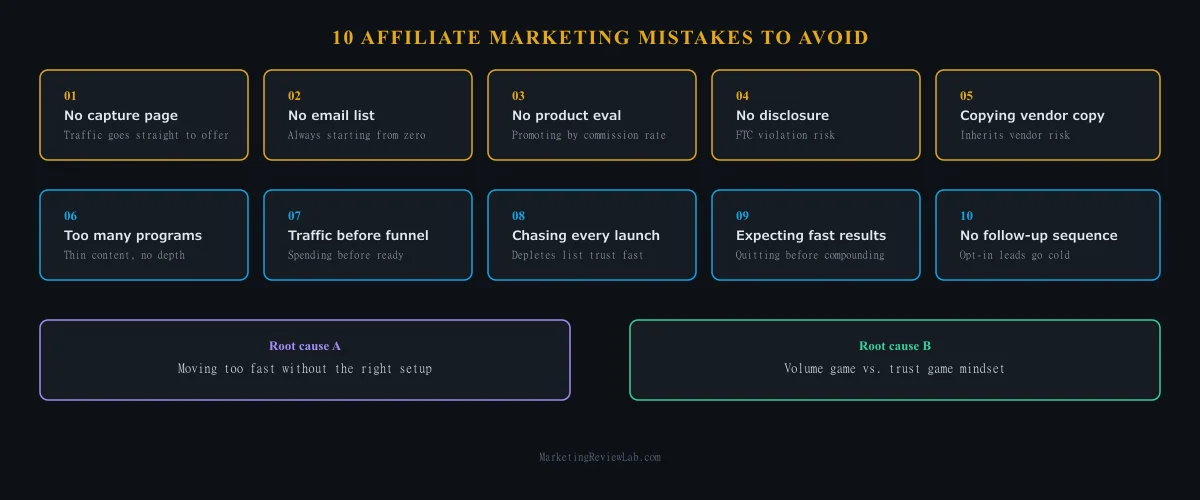
Mistake 1: Sending traffic directly to an affiliate offer
This is the single most expensive mistake in affiliate marketing. When a visitor lands on a vendor's sales page and leaves without buying, they are gone. You spent money or time to get that click and have nothing to show for it.
The fix is a capture page between your traffic source and the offer. The visitor opts in to your list first. Now you can follow up over days, not just on the first click. Most affiliate sales happen in the follow-up sequence, not at the initial landing.
LeadsLeap is a free-to-start platform that handles capture pages, opt-in forms, and autoresponder follow-up in one place. Set it up before you spend a dollar on traffic.
Mistake 2: Not building an email list
Closely related to mistake 1. An affiliate who does not build a list is always starting over. Every campaign requires new traffic. Every promotion reaches only the people in front of it right now.
A list is the one asset in affiliate marketing that compounds. A subscriber who did not buy today may buy next week, next month, or recommend the product to someone else. The affiliate email marketing guide covers what to send once you have a list running.
Mistake 3: Promoting products without evaluating them
Beginners often promote based on commission rate or launch buzz rather than on whether the product solves a real problem for a real buyer. This creates a predictable outcome: refunds, complaints, and a reputation that erodes before it is built.
Before promoting anything, run it through a basic checklist:
- What problem does this product solve?
- Who is it actually for?
- Who should skip it?
- What are the hidden costs or dependencies?
- What do the refund and support terms look like?
The Marketing Review Lab evaluation checklist is one structured way to do this. A product that cannot pass a basic checklist should not be promoted.
Mistake 4: Skipping the affiliate disclosure
This is not optional. If a recommendation can earn you a commission, readers should know that before they rely on it. The FTC endorsement guidelines require clear disclosure when a material connection exists between an endorser and a brand.
Disclosures do not hurt conversions. Readers generally understand that websites earn commissions. What hurts trust is finding out after the fact that a recommendation was undisclosed. Put the disclosure at the top of any affiliate content, not buried in a footer.
Mistake 5: Copying vendor sales page language
Vendor copy is written to sell. It often includes income claims, urgency tactics, and superlatives that are not appropriate for an affiliate's own audience. When a beginner copies vendor copy, they inherit all of the risk with none of the vendor's direct knowledge of the product.
Write in your own voice. Explain what the product does, who it is for, what to be careful about. If you have used it, say what you actually found. If you have not, say that clearly. Readers who feel misled are not repeat visitors.
Mistake 6: Joining too many programs
A common early pattern: join every affiliate program that looks interesting, add links across multiple pages, and wait for commissions to appear. The result is thin content across too many topics, no clear audience, and no depth on anything.
Start with one program or one niche. Learn it thoroughly. Build content around the buyer's actual decision, not around the commission. One well-built affiliate relationship that earns trust outperforms a dozen weak ones.
Mistake 7: Buying traffic before the funnel is ready
Solo ads, paid search, and paid social can deliver clicks quickly. They cannot make a weak funnel convert. Beginners often buy traffic before they have a capture page, a follow-up sequence, or any clarity on what they are trying to measure.
Traffic before funnel readiness is money testing nothing useful. Set up the capture page and at least a basic follow-up sequence first. Then buy a small test of 100 to 200 clicks and measure opt-in rate and cost per lead before spending more. The solo ads guide covers how to run a first test responsibly.
Mistake 8: Promoting every new launch
Launch marketplaces like WarriorPlus release dozens of new products every week. Beginners who chase every launch end up promoting products they have not evaluated to audiences that have not been built around a specific problem.
Every launch email sent without product knowledge is a withdrawal from trust. A list trained to receive only well-considered recommendations will convert better than one trained to receive everything.
Mistake 9: Expecting results in the first week
Organic traffic takes months to build. Email lists require consistent follow-up. Solo ad results emerge over a sequence of emails, not a single click. Beginners who expect fast results usually quit before the compounding effect has time to work.
The realistic timeline for affiliate marketing is measured in months, not days. The marketers who persist long enough to refine their funnel and build a responsive list are the ones who see durable results.
Mistake 10: No follow-up after the opt-in
Capturing an email address is the beginning, not the end. Beginners often set up a single welcome email and call it a sequence. A visitor who opts in and receives one email (or no emails) has been given no reason to return.
A basic follow-up sequence of five to seven emails that delivers useful content and introduces the offer naturally will outperform a single promotion sent to a cold list. The affiliate email marketing guide covers what a practical sequence looks like.
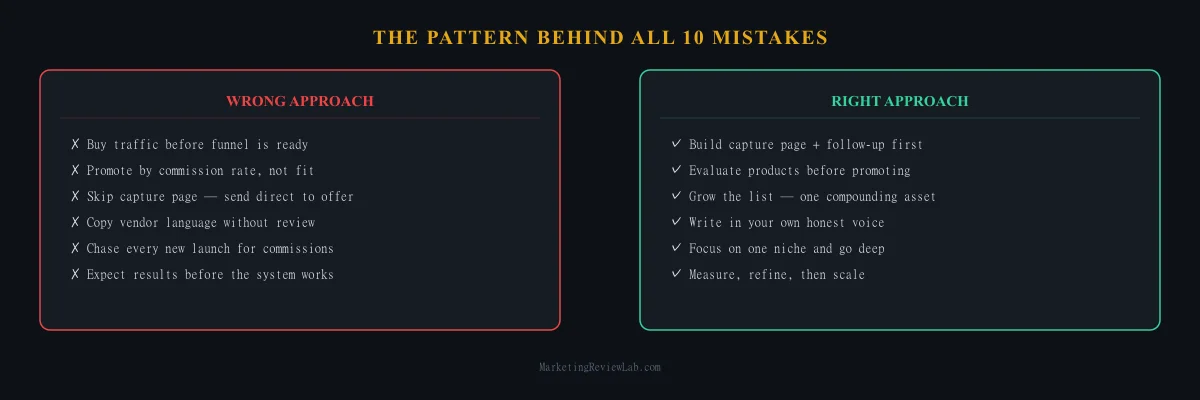
The pattern behind all ten mistakes
Every mistake on this list traces back to one of two things: moving too fast without the right setup, or treating affiliate marketing as a volume game rather than a trust game.
The antidote is the same in both cases: slow down, build the right foundation (capture page, follow-up, honest evaluation process) and add traffic only when the funnel is ready to do something with it.
For the setup side, see the traffic sources overview and start your capture page and list with LeadsLeap. For evaluating what to promote, start with the how affiliate marketing works guide.
Frequently asked questions
What is the most common affiliate marketing mistake?
Sending traffic directly to an affiliate offer without a capture page is the most common and most expensive mistake. When a visitor leaves without buying, that click is gone permanently. A capture page turns each visitor into a potential follow-up opportunity.
Why do most beginners fail at affiliate marketing?
Most beginners fail because they start promoting before their funnel is ready, choose products based on commission rate rather than fit, and stop before the follow-up sequence has had enough time to work. The mechanics are straightforward; the discipline to set up properly and stay consistent is where most people fall short.
Is affiliate disclosure really required?
Yes. The FTC requires clear disclosure when a material connection exists between an endorser and a brand, including affiliate commissions. The disclosure should appear prominently before the recommendation, not hidden in a footer or a disclaimer page linked from the bottom of the article.
How long does it take to make money with affiliate marketing?
There is no universal timeline. Organic search traffic typically takes months to build. Paid traffic can generate data faster, but results depend on funnel quality, offer fit, and follow-up. Treat the first several months as a learning period rather than an income period and you will make better decisions throughout.
What should a beginner affiliate marketer focus on first?
Set up a capture page and a basic email follow-up sequence before promoting anything. Choose one offer you can explain honestly. Drive a small amount of traffic, measure what happens, and improve based on what the data shows. Do not scale until the fundamentals are working.





0 Comments